
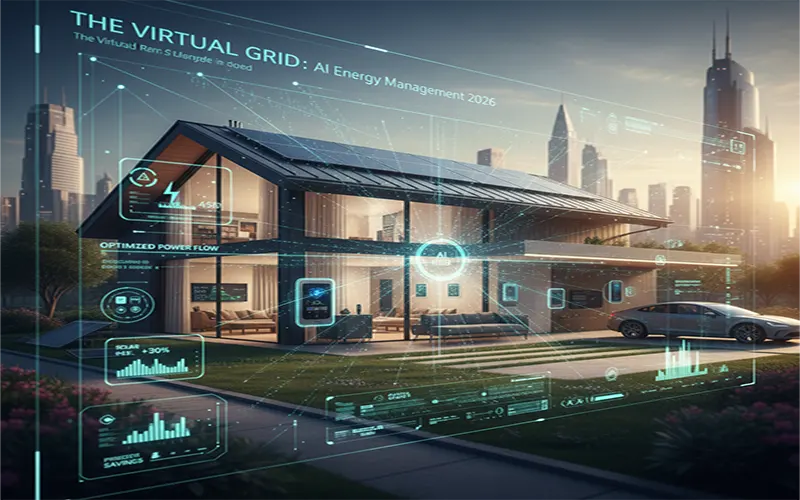
The era of the “smart home” driven by simple schedules and remote control is officially over. Welcome to the AI Energy Era, where your home no longer just responds to commands but anticipates your needs, learns your habits, and optimizes its energy consumption autonomously. In 2026, Artificial Intelligence has moved beyond the cloud, integrating directly into the “edge” of your home—local devices equipped with Neural Processing Units (NPUs) that make faster, more secure energy decisions, often without needing a constant internet connection.
This evolution from user-driven automation to Autonomous Efficiency isn’t just about convenience; it’s about significant cost savings, reduced carbon footprints, and a more resilient power grid. Your home is transforming into its own virtual power plant, constantly negotiating with the utility to minimize your bills and maximize sustainability.
The Predictive Power of AI: Learning Your Home’s Rhythms
The core of AI’s energy revolution lies in its ability to predict. Unlike static programming (“turn off lights at 10 PM”), AI continuously gathers data to anticipate future needs and conditions:
- Occupancy Patterns: Forget rigid schedules. AI-powered sensors and cameras (with privacy-first edge processing) learn exactly when family members are home, in which rooms, and for how long. The HVAC system, for instance, won’t blast cool air into an empty living room just because it’s 3 PM. It knows you usually arrive at 5:15 PM and will begin pre-cooling based on that.
- Weather Integration: Beyond just current temperature, AI taps into hyper-local weather forecasts. Expecting a heatwave tomorrow? The AI will “pre-cool” your home a few degrees lower this evening when electricity is cheaper, allowing your AC to run less during peak demand. Anticipating a sudden cold snap? Your smart thermostat will pre-heat efficiently, factoring in solar gain from predicted sunshine.
- Appliance Behavior: AI identifies the energy signature of individual appliances. It knows when your refrigerator is running an unusually long cycle (indicating a potential seal leak) or when your washing machine’s motor sounds a bit off, flagging predictive maintenance alerts.
The Role of Matter 1.3+: AI’s Universal Translator
The widespread adoption of Matter 1.3+ in 2026 is critical to AI’s success. This latest iteration of the universal smart home standard allows AI to “talk” to a vast array of devices, including major appliances.
- Real-time Energy Reporting: Matter-enabled dishwashers, dryers, and ovens now report their real-time power consumption directly to your central AI hub.
- Granular Control: Instead of just “on/off,” AI can now command specific cycles, delay starts, and even optimize heating elements based on grid conditions. For example, your AI can tell your Matter-enabled oven to preheat during an off-peak hour, then hold temperature until you’re ready to cook.
This level of interoperability and data transparency is what truly unleashes AI’s potential as a Virtual Energy Manager.
Smart Grid & Dynamic Pricing: The Art of “Load Shifting”
One of AI’s most powerful applications is Load Shifting, a concept previously limited to commercial buildings but now standard in AI-driven smart homes. In 2026, most utilities offer dynamic pricing, where electricity costs fluctuate throughout the day based on demand and generation.
| Traditional Smart Home (2023) | AI-Driven Energy Home (2026) |
| Static Schedules: Lights turn off at 10 PM. | Learned Patterns: Lights turn off when the last person leaves the room. |
| User-Controlled Appliances: Dishwasher run after dinner. | Autonomous Load Shifting: Dishwasher runs at 2 AM when power is cheapest (or free!). |
| Reacts to Weather: AC turns on when thermostat hits 75°F. | Anticipates Weather: Home pre-cooled based on tomorrow’s forecast & energy prices. |
| Limited Device Data: Appliance energy consumption unknown. | Matter 1.3+ Reporting: Real-time energy data from all major appliances. |
| No Grid Interaction: Consumer of energy. | Smart Grid Integration: Participates in demand response, earns credits. |
AI constantly monitors these utility prices. It will automatically run energy-intensive tasks like charging your EV (Electric Vehicle), running the clothes dryer, or heating your water during off-peak hours, or even during periods of negative pricing, where the grid literally pays you to consume excess renewable energy (a growing phenomenon in 2026 in regions with high solar/wind penetration).
Solar & Battery Optimization: Your Home as a Power Plant
For homes with solar panels and battery storage systems (like a Tesla Powerwall or Enphase Encharge), AI elevates energy independence to a new level.
- Predictive Storage: AI learns your energy usage profile, solar generation patterns, and upcoming weather. It decides when to store excess solar energy in your battery, when to draw from the battery, and crucially, when to sell surplus back to the grid for maximum profit, especially during peak demand when prices are highest.
- Outage Preparedness: In the event of a predicted power outage, AI can prioritize charging your home battery system, ensuring critical circuits remain powered for longer.
Top AI Energy Tools of 2026
Several companies are leading this charge, integrating sophisticated AI into home energy management:
- Span Smart Panels: These intelligent electrical panels replace your old breaker box, offering circuit-level energy monitoring and AI-driven load management. They are the backbone for AI-driven energy decisions.
- Schneider Electric’s Wiser Home Ecosystem: Wiser integrates energy monitoring, HVAC control, and smart plugs, all powered by an AI engine that learns and optimizes.
- BrainBox AI (Residential): Known for commercial building optimization, BrainBox AI is now offering simplified residential solutions that use predictive algorithms for HVAC.
The ROI of Autonomous Efficiency
The transition to AI-driven energy management in 2026 isn’t a luxury; it’s a financial imperative and an environmental responsibility. By leveraging the predictive power of machine learning, the interoperability of Matter 1.3+, and dynamic grid pricing, AI can:
- Reduce Home Energy Bills by up to 30%: Significant savings that quickly offset the initial investment in smart tech.
- Lower Carbon Footprint: By optimizing consumption and utilizing renewable energy more effectively, your home becomes a greener haven.
- Increase Home Resilience: Autonomous systems ensure your home operates efficiently, even during grid fluctuations or outages.
Your home is no longer just a dwelling; it’s an intelligent, self-optimizing entity participating in the “virtual grid,” proving that smart technology can be both deeply personal and globally impactful.