
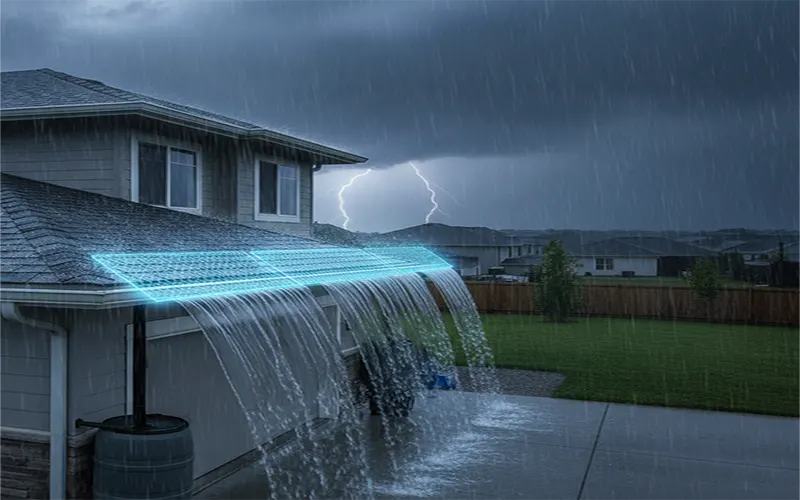
In 2026, the traditional rainy season has been replaced by a more volatile “convective” weather pattern. Homeowners are increasingly facing short, intense bursts of rainfall—often 3 to 4 inches per hour—that can turn a standard gutter system into a cascading waterfall in minutes.
Most residential gutters were historically sized for “100-year storms” that no longer match today’s climate reality. When your gutters overflow, it isn’t just a nuisance; it is a direct threat to your home’s structural integrity, leading to foundation erosion, basement flooding, and siding rot. To protect your home in 2026, you must transition from simple “maintenance” to “volume management.”
Phase 1: The Geometry of Drainage (Pitch & Size)
The most common reason for overflow in heavy rain—even when gutters are clean—is that the system simply cannot move the volume of water fast enough.
- The 6-Inch Standard: While 5-inch gutters were the 20th-century norm, 2026 standards have shifted toward 6-inch K-style seamless gutters. A 6-inch gutter holds approximately 2 gallons of water per foot, a 67% increase in capacity over 5-inch models. This extra inch provides the critical “surge capacity” needed for high-intensity downpours.
- The Pitch Rule: Gravity is your only motor. Gutters must be sloped precisely at 1/4-inch for every 10 feet of run. If the pitch is too shallow, water pools and creates “dead zones” that overflow during a surge. If the pitch is too steep, water moves so fast it overshoots the downspout outlet.
Phase 2: Solving the Downspout “Bottleneck”
If your gutters are full but your downspouts are only half-flowing, you have a bottleneck. In 2026, the industry has moved away from the small 2×3 inch downspouts.
- Upgrade to 3×4 Inches: Switching to 3×4 inch downspouts nearly doubles the drainage capacity of each outlet. This allows the trough to empty faster, preventing the back-up that causes overflow.
- The “1 per 20” Rule: For extreme storms, a single downspout at each end of a long run is no longer sufficient. Install an additional downspout for every 20 to 25 feet of gutter. Increasing the number of outlets is the most effective way to reduce the water load on any single section of the system.
Phase 3: High-Flow Guards and Splash Management
Not all gutter guards are created equal. In fact, some can actually cause overflow during heavy rain.
- Micro-Mesh vs. Reverse Curve: Reverse-curve guards rely on surface tension to pull water into the gutter. In a 2026 deluge, the water often moves too fast for this tension to work, causing it to “overshoot” the gutter entirely. Stainless steel micro-mesh is the preferred 2026 solution; it blocks debris but allows high volumes of water to pass through the screen.
- Valley Splash Guards: Roof valleys—where two roof planes meet—act as high-speed funnels. During heavy rain, water “firehoses” out of these valleys. Installing Splash Guards (L-shaped metal diverters) at these high-velocity points forces the water into the gutter rather than over the edge.
Phase 4: Underground Infrastructure
Overflow often starts at the bottom. If your downspout empties into a clogged underground pipe, the water will back up all the way to the roof.
- Catch Basins: Replace standard “elbow” connectors with a Catch Basin at the base of your downspouts. These small underground boxes trap shingle grit and debris before they enter your main drainage pipes, and they feature a grate that allows excess water to bubble out safely if the underground system is overwhelmed.
- Pop-up Emitters: Ensure your yard’s pop-up emitters are clear of grass and mulch. A stuck emitter is the #1 cause of “silent” gutter backup.
2026 Tech Spotlight: IoT Gutter Sensors
The newest weapon against overflow is the Smart Gutter Sensor (e.g., Infrasolute or ETOR-55). These IoT devices sit in your gutter and monitor water levels and moisture.
- Predictive Alerts: They send an alert to your phone if water is “standing” (indicating a clog) before the rain even starts.
- Flow Monitoring: During a storm, they can notify you if the water level in the trough is reaching the “critical overflow” point, allowing you to address the issue before it causes foundation damage.
Gutter Specification Comparison
| Feature | Standard (Old) | Extreme Storm Spec (2026) | Benefit |
| Gutter Width | 5 Inches | 6 Inches | 67% more water capacity. |
| Downspout Size | 2×3 Inches | 3×4 Inches | Prevents outlet bottlenecks. |
| Hanger Spacing | 36 Inches | 18–24 Inches | Prevents sagging under heavy water weight. |
| Monitoring | Manual/Visual | IoT Water Sensors | Real-time overflow alerts. |
The Foundation Insurance Policy
Preventing gutter overflow is the single most cost-effective way to protect your home’s foundation. While a 5-inch gutter might have sufficed in the past, the “Extreme Storm” reality of 2026 demands a system with higher capacity, larger outlets, and smarter monitoring. By upgrading to 6-inch troughs and ensuring your downspouts are clear and correctly sized, you turn your home’s drainage into a high-performance system capable of weathering any deluge.
Post-Storm Audit Sidebar
After a heavy rain, do a 5-minute walk-around:
- Check for “Tiger Striping”: Dark lines on the front of your gutters indicate they overflowed.
- Look for Scouring: Holes in the mulch or dirt under the gutters mean water is overshooting or leaking.
- Test the Emitters: Ensure water is actually flowing out of your underground drains.