
For decades, the standard for indoor lighting was a simple toggle: “on” or “off.” In 2026, we understand that this binary approach has a profound biological cost. Modern homes are now designed around Human-Centric Lighting (HCL), a strategy that recognizes light not just as a way to see, but as the primary drug that regulates our internal chemistry.
The breakthrough in 2026 isn’t just about better bulbs; it’s about the integration of Matter 1.5 and a deep scientific understanding of the ipRGCs (intrinsically photosensitive retinal ganglion cells) in our eyes. These cells are the “biological gatekeepers” that translate light into chemical signals for our brain’s master clock, the Suprachiasmatic Nucleus (SCN). By mastering your smart home lighting, you are quite literally hacking your own biology.
Phase 1: The Morning “Blue Reset” (06:00 – 10:00)
Your circadian rhythm begins the moment light hits your eyes in the morning. To “reset” your clock and shake off sleep inertia, you need high-intensity light with a strong concentration of blue wavelengths—specifically in the range of $460\text{–}480\text{ nm}$. This is the peak sensitivity range for melanopsin, the photopigment that suppresses melatonin (the sleep hormone) and triggers the release of cortisol and serotonin.
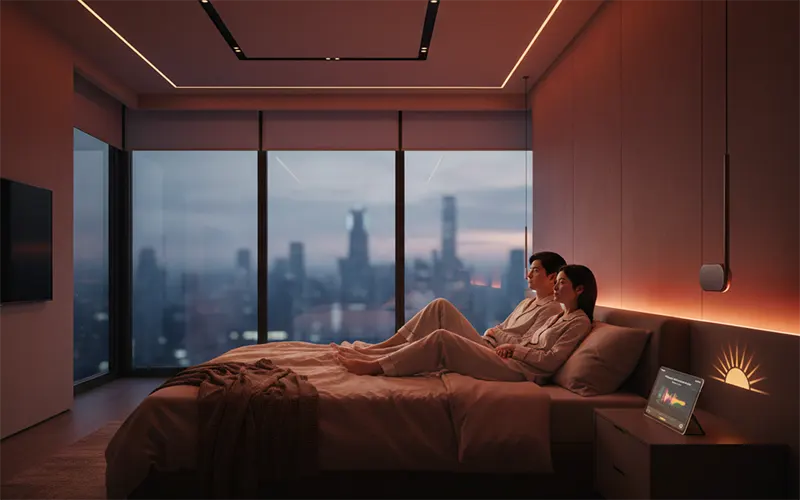
- The Sunrise Automation: In 2026, we no longer use jarring alarms. Instead, Matter-enabled systems use Sunrise Effects to gradually brighten your bedroom over 30 minutes, moving from a deep amber to a crisp 6500K “Daylight” blue-white.
- Melanopic EDI: Aim for high Equivalent Daylight Illuminance during these hours to ensure your brain receives a clear “Day Is Here” signal.
Phase 2: The Midday Peak (10:00 – 16:00)
During the middle of the day, the goal is cognitive performance and metabolic health. Stagnant, dim office lighting is a primary cause of the “afternoon slump.”
- Daylight Harvesting: Modern smart sensors now use Daylight Harvesting to measure the natural sun entering your room. If the sun is bright, your smart lights will dim to save energy; if clouds roll in, they automatically increase to 5000K to maintain your alertness.
- Cool White Dominance: Research shows that keeping color temperatures above 4000K during work hours maintains a high “circadian stimulus,” keeping your mood stable and your focus sharp.
Phase 3: The Golden Hour & Melatonin Bridge (18:00 – 21:00)
This is the most critical window for sleep preparation. As the sun sets, your home should “warm up.” In 2026, we focus on the “Warm Dim”—not just lowering brightness, but shifting the spectrum.
- The Vertical vs. Horizontal Rule: This is a key 2026 design principle. Your ipRGCs are more concentrated in the bottom of your retina, making them more sensitive to light coming from above (overhead fixtures). In the evening, your smart home should automatically turn off ceiling lights and switch to horizontal light—table lamps and floor-level LED strips.
- Spectrum Shift: Shift your lights to 2700K or lower. Matter 1.5 allows for Adaptive Lighting that does this automatically, removing the blue-cyan spikes that trick your brain into thinking it’s still midday.
Phase 4: The Nighttime “Blackout” (Bedtime)
Once you head to bed, the goal is near-total darkness. However, mid-night movement is inevitable.
- The Amber Path: Instead of turning on a bright bathroom light (which can instantly reset your circadian clock), 2026 homes use Amber or Red Path Lights. These colors have a wavelength of approx. $630\text{–}660\text{ nm}$, which has almost zero effect on melatonin production. You can see where you’re going without “waking up” your brain.
2026 Tech Spotlight: Adaptive Intelligence
The biggest leap in 2026 is that you no longer have to manage these schedules yourself.
- Matter 1.5 Adaptive Lighting: This standard allows your bulbs to communicate directly with your geolocation. Your lights will shift their color temperature in perfect sync with the sun’s position at your specific latitude, all without you opening an app.
- Acoustic-AI Sensors: New sensors like the Sleepal series use ultra-quiet acoustic monitoring to detect your actual sleep stage. If you are in deep sleep, your lights remain locked. If the sensor detects you are in a light “wake” phase near your alarm time, it can subtly trigger the sunrise effect to make waking up effortless.
The 24-Hour Circadian Schedule
| Time of Day | Target Color (K) | Intensity | Goal |
| 07:00 | 6500K (Cool Blue) | 100% | Melatonin Suppression / Wake |
| 12:00 | 5000K (Bright White) | 80–100% | Alertness / Productivity |
| 19:00 | 2700K (Warm Gold) | 30–50% | Melatonin Bridge / Relaxation |
| 22:00 | <2000K (Amber/Red) | 1–5% | Sleep Preparation |
The ROI of Luminous Wellness
Investing in a smart lighting system in 2026 isn’t just about aesthetics; it’s a long-term investment in your metabolic and mental health. By aligning your home’s lighting with the $460\text{–}480\text{ nm}$ blue-light sensitivity of your ipRGCs, you can reduce sleep latency, improve mood stability, and wake up feeling truly restored.
In a world that never sleeps, your smart home is the only thing that can give your biological clock the quiet, darkness, and rhythm it truly needs to thrive.
Melatonin Protection Checklist:
- [ ] Enable Adaptive Lighting in your Matter-compatible hub.
- [ ] Switch to Low-Level (Horizontal) lighting after 8:00 PM.
- [ ] Install Amber/Red path lights for nighttime navigation.
- [ ] Use Full-Spectrum LED strips for morning “light showers.”