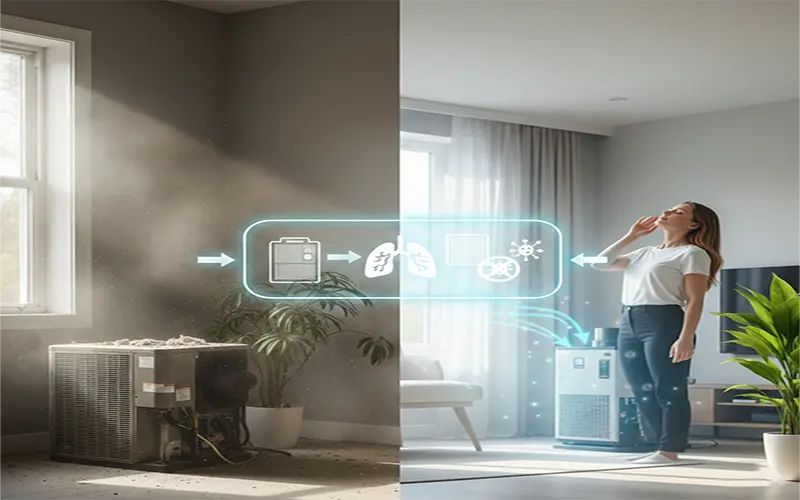
In 2026, the primary role of a home heating and cooling system has undergone a fundamental shift. No longer just a tool for thermal comfort, the modern HVAC system is now recognized as a home’s “respiratory system.” With outdoor challenges like extended wildfire smoke seasons and high pollen counts becoming the new normal, our indoor sanctuaries are under pressure.
Current environmental data reveals a startling reality: indoor air is often two to five times more polluted than outdoor air. From off-gassing furniture (VOCs) to microscopic mold spores, our homes can suffer from “Sick Building Syndrome” if left unmanaged. In this new landscape, regular HVAC maintenance is no longer about saving a few dollars on the electric bill; it is a critical health defense strategy.
Section 1: The Filtration Frontline
The air filter is the first and most vital line of defense in your IAQ strategy. In 2026, the industry has largely moved toward MERV 13 as the standard for health-conscious households.
- Understanding MERV Ratings: While a basic MERV 8 filter catches dust bunnies, it misses the dangerous sub-micron particles. A MERV 13 filter is capable of capturing up to 90% of airborne particles between 1.0 and 3.0 microns, including bacteria and smoke.
- The “Pressure Drop” Myth: There is a common fear that high-efficiency filters “choke” the HVAC motor. While a thick filter does provide more resistance, a well-maintained system with a clean blower motor and calibrated static pressure can handle a MERV 13 filter with ease. Regular maintenance ensures the motor is strong enough to pull air through these denser materials without overheating or losing efficiency.
Section 2: The Mold & Moisture Battle
The interior of your HVAC system is naturally dark and damp—the perfect environment for a biological “petri dish.”
- Evaporator Coils: As air passes over the cooling coils, moisture condenses. If these coils are covered in a layer of dust, that dust becomes a food source for mold and mildew. This leads to “Dirty Sock Syndrome,” a persistent, musty odor caused by bacterial colonies. Professional cleaning of these coils is essential to keep them from releasing spores into your airstream.
- Condensate Drain Lines: When algae or “slime” builds up in your drain lines, water backs up. Stagnant water is a breeding ground for Legionella and other pathogens. Maintenance technicians now use specialized bio-tablets and high-pressure flushes to ensure these lines remain clear and sterile.
Section 3: Modern IAQ Add-ons (The 2026 Standards)
Standard filtration is often not enough for a modern home. Many 2026 HVAC systems now incorporate active purification technologies:
- UV-C Germicidal Lights: Installed over the coils, these lights use ultraviolet energy to scramble the DNA of viruses and mold, rendering them harmless before they can replicate.
- Bipolar Ionization: This technology releases charged ions into the air. These ions attach to fine particles (like smoke and VOCs), causing them to “clump” together so they are heavy enough to fall out of the air or large enough to be caught by your MERV 13 filter.
- ERVs (Energy Recovery Ventilators): Modern homes are built “tight” to save energy, but this traps stale air. An ERV allows your home to “exhale” CO2 and toxins while “inhaling” fresh, filtered outdoor air, exchanging the thermal energy in between to keep your bills low.
Section 4: AI & Predictive IAQ
One of the most significant advancements in 2026 is the integration of Matter 1.3 compatible air quality sensors.
In the past, you only knew your air was dirty if you saw dust or started sneezing. Today, smart sensors monitor PM2.5 (fine dust), VOCs (chemicals), and CO2 in real-time. Through the Matter standard, these sensors communicate directly with your HVAC system. If you burn a piece of toast or use a heavy cleaning spray, the AI-driven hub detects the spike and automatically triggers the HVAC fan to “scrub” the air through the high-efficiency filter until levels return to normal.
Section 5: The Ductwork Dilemma
Even the best filter is useless if your ducts are leaking. It is estimated that 20–30% of the air moving through a typical system is lost due to leaks.
More importantly, leaky return ducts in attics or crawlspaces act like a vacuum, pulling in “unfiltered” air filled with insulation fibers, rodent dander, and mold. Part of a 2026 professional maintenance visit includes a Duct Integrity Check, ensuring the air you breathe is actually the air that went through the filter.
Summary Table: Pollutants vs. Solutions
| Pollutant Type | Examples | Best HVAC Solution |
| Particulates | Dust, Pollen, Dander | MERV 13+ Filtration |
| Pathogens | Viruses, Bacteria, Mold | UV-C Lights / Bipolar Ionization |
| Chemicals (VOCs) | Paint fumes, Cleaners | Bipolar Ionization / ERV |
| Gases | CO2, Cooking Odors | ERV (Fresh Air Exchange) |
The Health ROI
Regular HVAC maintenance in 2026 is no longer a “luxury” service; it is a preventative health measure. By ensuring your system is clean, calibrated, and equipped with the right filtration and purification tools, you are directly impacting your family’s respiratory health, sleep quality, and cognitive function.
A well-maintained system doesn’t just keep you cool in the summer and warm in the winter—it ensures that every breath you take inside your home is as clean as a mountain breeze.
Healthy Air Checklist:
- [ ] Change MERV 13 filters every 90 days.
- [ ] Schedule a professional coil cleaning once per year.
- [ ] Verify ERVs or fresh air intakes are clear of debris.
- [ ] Check Smart IAQ sensor calibration via your home app.