
Understanding when to replace your unit is no longer just about waiting for a flood. It’s about recognizing the “silent” warnings of inefficiency and mechanical fatigue. Here is the cold truth about the seven signs that your water heater is nearing the end of its life.
1. The Decade Milestone (Age)
In 2026, the first thing any plumber will ask is the age of your unit. Most traditional tank-style water heaters are designed to last 8 to 12 years. If your unit was installed before 2016, you are officially living on borrowed time.
How to find the age:
Look at the manufacturer’s sticker for the serial number.
- Rheem/Ruud: The first four digits are the month and year (e.g., 0526 is May 2026).
- A.O. Smith: The first two digits are the year (e.g., 26 means 2026).
- Bradford White: This is a code. The first letter is the year (e.g., “C” can mean 2006 or 2026; given the 20-year cycle, if it looks old, it’s likely from the previous cycle).
2. The “Rock Concert” in the Tank (Noise)
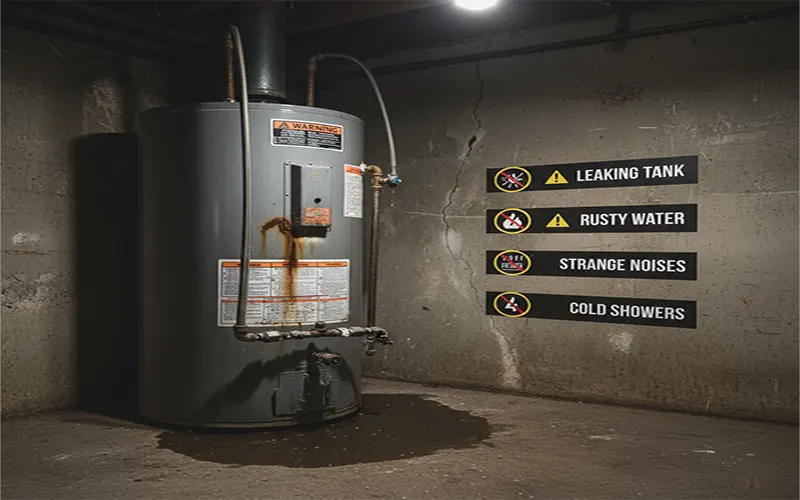
As a water heater ages, it begins to make banging, popping, or rumbling sounds. This isn’t a ghost; it’s Sediment Calcification. Over years of heating hard water, minerals settle at the bottom and harden into a thick crust.
- The Result: The burner has to heat through that “rock” layer to reach the water. This causes the tank to overheat, leading to metal fatigue and eventually a structural breach.
3. Rusty or Murky Output
If your hot water looks like tea or has a metallic scent, the tank is likely corroding from the inside out.
- The Anode Rod: Every tank has a “Sacrificial Anode Rod” designed to rust so the tank doesn’t. Once that rod is fully dissolved (usually by year 5), the water starts eating the steel tank itself. If you see rust, the “sacrifice” is over, and the tank is next.
4. The Telltale Puddle (Leaks)
Not all leaks mean a replacement, but where the water is coming from matters immensely.
- Valves/Fittings: Leaks from the top or the side valves (T&P valve) are often repairable for a few hundred dollars.
- The Base: If you see water pooling at the very bottom of the tank, it usually indicates a fracture in the inner liner. In 2026, there is no reliable way to “patch” a cracked inner tank—replacement is the only safe option.
5. The Lukewarm Fade
If your showers are getting shorter, or the water never hits that “steamy” temperature anymore, your unit is losing its punch.
- Electric Units: One of the two heating elements has likely burned out.
- Gas Units: The “Dip Tube” (which sends cold water to the bottom to be heated) may have disintegrated, causing cold water to mix with the hot water at the top of the tank.
6. Skyrocketing Utility Bills
As of 2026, energy costs have made efficiency a top priority. A water heater full of sediment can use up to 40% more energy to produce the same amount of hot water as a clean unit. If your gas or electric bill has taken a mysterious jump, your water heater is likely “working overtime” just to keep up.
7. Frequent Repairs (The 50% Rule)
The “50% Rule” is the industry standard for 2026. If a single repair cost (plus labor) exceeds 50% of the price of a new unit, it is financially wiser to replace it. Common “expensive” repairs like gas control valve replacements or heat exchanger issues on tankless models often fall into this category.
2026 Repair vs. Replacement Cost Guide
| Scenario | Est. Repair Cost | Est. Replacement (Installed) | Decision |
| Faulty Thermostat | $150 – $300 | $1,200 – $2,500 | Repair |
| Leaking Tank Base | N/A | $1,200 – $2,500 | Replace |
| Old Unit (>12 yrs) | $400 (Multiple parts) | $1,200 – $2,500 | Replace |
| Burnt Heating Element | $200 – $400 | $1,200 – $2,500 | Repair |
The 2026 Replacement Landscape: Making the Switch
If you decide to replace your unit today, you aren’t stuck with another old-school tank.
- Heat Pump Water Heaters (Hybrid): These are the 2026 gold standard. They are up to 3x more efficient than electric tanks and often qualify for a 30% Federal Tax Credit (up to $2,000) through the end of the year.
- Tankless (On-Demand): Best for small homes or large families who never want to run out of hot water. They take up 90% less space but require a higher initial investment.
Pro-Maintenance Tip: To extend your current unit’s life, flush the tank annually to remove sediment and check your anode rod every 3 years.